Saturday, September 18, 2010

Build a Facebook Landing Page for Your Business

What is FBML?


FBML is Facebook’s version of HTML, This particular application, which was created by Facebook and can be added to your pages, allows you to create a “web page” within a tab or box that you can attach to your page.

How do find the Static FBML application and install it?

Like any other application, Static FBML can be found by using the search on Facebook. Simply type in: Static FBML.


In the results list you will find listings for both Applications and Pages. You are looking for the Application so click on that.
Once you’re on the page for the Static FBML application, you will look for the link to “add application to my page” which should be at the top left of the screen, under the logo for the application.

 Clicking the link brings up a popup window which allows you to select the page you’d like to add it to

After you have added the app, pull up your Facebook fan page. Now you have a new tab called “FBML” on your page but it is blank. To edit FBML click on “Edit Page” of your fan page.

In list of application find the Static-FBML and click on “Edit” to add content to FBML Page.

After getting the Editing mode two boxes will appears “Box Title” & “FBML”. In Box Title give name for your FBML TAB and at FBML add Html Content which will display as a static page at FBML TAB.


Save the changes and go to your fan page.  The FBML TAB will appear with given title to FBML box. To set it as a landing page just click on “Setting” tab at your page wall. You will find drop down box named “Default Landing Tab for Everyone Else”. From the list select FBML tab. That’s all.


After completing this Process the FBML Tab will appear first whenever your fan page will open. See how easy is this!


‘Ways for Improving Google Page Rank’

1) Make sure that at least one link to Google. They need the quality traffic as well. Do not be greedy and hog everything for you. This is not surprising the pages. Remember - Google is about - so that more traffic will send him best.


2) Use invisible text, but its close - such as paints and 00FF33 00FF66 made both secure browser, but as most people can not tell the difference is close. While Google is more than 50 staff doctors - none of them perhaps - it then use it know


3) Dots, Dots, and more points. Place the bottom of your document will look like this:

.............

Then link each of your pages - be sure to link with one of Google and Yahoo for another good measure. Do not link to other sites worldwide (excluding your own), not search engines. Not even link to a page where the previous search engines - like AltaVista.


4) H1 tags used all throughout your site (other than the title and header information). You can use CSS to make them smaller, and Google gives you all for making top bookoo great (even if it does not look great, the user).


5) If all else fails - Almost 10 wrapped in spot number 10 envelope (at least one aluminum layer or foil wrap around it). Enter the URL above, the serial number on the front panel. If not match, then this problem - if Google likes long URLs.


6) Do not copy content from another site. Even if you are copying and republishing your own content of a page or site to another, do not. Google's algorithm can not make a difference and provide either the original site and credit downgrade or other downgrading all sites that publish duplicate content. Google acts harshly towards any type of scraping content, even if you are totally innocent. Once your page rank is demoted, it is nearly impossible to recover again.


7) Use the Meta keyword tag too. With commas mechanism. Make sure the words you more than three times in a row, so be sure not to repeat. Google only document the first 101k indexes - do not use too many.


8) This recommendation is without doubt the most powerful here. Make at least three pages on your site and link as follows:

Page 1 >>>>>> Page 2

>>>>>> Page 2 Page 3

And the kicker

1 page 3 >>>>>> Page


The following pages on Google, that page 3-2 pages 2-1 pages will give you the points - again, if you link to a page - everything will start again. How many points can not count to the end of the week? Just do not abuse it too much - or a site to promote as many of them to complain.

Effective Link Building Tips


These link building techniques are potential to assure that you will receive free links from already established websites. These are different from the content-oriented development strategies and provide one-way organic links.

Case 1

Submit your site to Web Directories - This monotonous process can be helpful to get you several back-links.

Submit Press Releases to PR Sites – A good way to get a free link; several PR websites will distribute your website/product/service/event/much-more….lunching details to various online news outlets.

Reciprocal Links with Similar Websites - Reciprocal linking can be useful from the beginning; it’s important to choose highly relevant websites to bring not only back-links but traffic also.

Web 2.0 Pages - It’s help you to insert a bunch of anchor text links to your website along with your feed content. E.g. Squidoo lens, Hubpages

Article Submissions – Create an article using rich content on your niche topic & submit it to article directories to generate back-link as well as traffic.

Social Media Profiles - There a whole bunch of social websites online which allow you to insert a link to your website on the profile page. Social sites online profile page, that you have a link on its website a whole bunch of permits out there. Sign up for some of them, preferably with a username and an avatar that your company, brand. It comes in handy if you could in the future through social sites to promote your site to decide. E.g. Twitter, Facebook

Social Bookmarking Websites - Social bookmarking websites are often crawled by search engines and their links can help to get a website indexed soon. E.g. Netscape or Digg

Forum Signatures - Sign up for some forums in your niche and start contributing to ongoing discussions & insert the homepage or some inner page’s link of your site as a signature.

CASE 2

Create a Tool, Theme or Widget - Make an add-on application or template related to social networking website or platform & include a credit link that points back to your designated website.

Blogs on Other Blog Platforms – Set up your blog on different blog networks which link to specific WebPages on your website like WordPress.com, Blogger and Xanga.


Comment on Other Blogs - Start commenting on relevant and popular sites in your niche and try to avoid keyword names or signature links.

Guest posting on other blogs – Send your article and press releases to certain blogs in your niche which will help you to get relevant links and traffic.

Hold Contests - Some websites often offer contests in a bid to attract anchor text links from bloggers. The contests allow you to establish the specific anchor text.

Collaborative Projects - Originate an article specifically for a writing project, or blog carnival; and depends on the number and generousness of the participants involved; it will give you a couple of back-links.

Offer your Expertise – Use your specific skill such as web design, copywriting, translation or SEO and offers excellent branding and take credit link for your Webpage.

Top 10 Internet Marketing Strategies

Internet marketing can attract more people to your website, increase customers for your business, and enhance branding of your company and products. If you are just beginning your online marketing strategy the top 10 list below will get you started on a plan that has worked for many.

  1. Start with a web promotion plan and an effective web design and development strategy.
  2. Get ranked at the top in major search engines, and practice good Search Optimization Techniques.
  3. Learn to use Email Marketing Effectively.
  4. Dominate your marketing niche with affiliate, reseller, and associate programs.
  5. Request an analysis from an Internet marketing coach or Internet marketing consultant.
  6. Build a responsive opt-in email list.
  7. Publish articles or get listed in news stories.
  8. Write and publish online press releases.
  9. Facilitate and run contests and giveaways via your web site.
  10. Blog and interact with your visitors.
By following the above tips you'll be on your way to creating a concrete internet marketing strategy that could boost your business substantially.

source: http://marketing.about.com/od/internetmarketingstrategy/a/internettips.htm

11 Free Tools for Social Media Optimization

Plenty of bloggers are talking about the inevitable intersection of social media marketing and search engine optimization. Heck, we’ve beenblogging about SMO since 2006! Keyword optimized social content and channels of promotion provide abundant signals to search engines for improved visibility on standard, social and real-time search.
The changing nature of social media marketing and optimization create the need for tools whether for research, marketing and promotion or analytics. Here are 11 social media and SEO tools you might find useful:
Below are screen shots of each tool with a more detailed description of how you might use them.
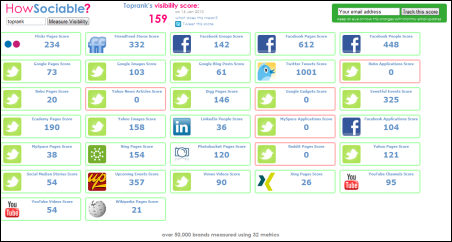
HowSociable is a useful tool to quickly gauge the social presence of a particular keyword or brand name. Agencies like TopRank Marketing will use this kind of tool (customized) to take snapshots of customer social presence metrics for social media optimization programs. For each social site polled, you can clickthrough to see specific mentions.  This is a characteristic of more advanced social media monitoring tools, but for those that want a quick glimpse, HowSocialble is easy to use and the price is right, just like these free social media monitoring tools. However, if you want more comprehensive brand search and monitoring, then a paid social media measurement tool is worth the investment.
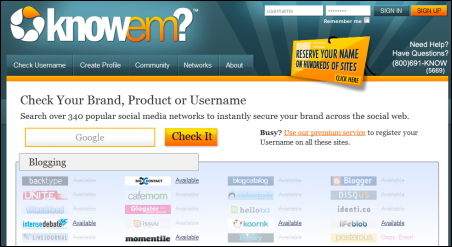
KnowEm is both a free and a paid service that will help you easily and quickly check whether your brand terms or other keywords have been registered as social profiles on a wide variety of social media web sites. Everything from blogging platforms to social news and bookmarking services are included. If you don’t want to complete all those profiles yourself, you can pay knowem to do it for you.  Companies invest a lot in building their brand, so this tool is helpful both for creating off site promotion channels as well as guarding against brand name squatters.
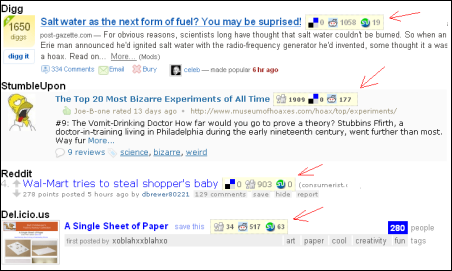
Social Media for Firefox is the only browser addon in our list and can be a handy tool to identify upcoming news items that are gaining popularity on certain social news and bookmarking services. A big part of building a more influential user profile is to be a consistent source of submissions for articles that become popular. This addon helps identify articles that are becoming popular on services like Digg, Reddit and StumbleUpon giving you a heads up to submit to other services.  The logic is that if a news item becomes popular on one service it has a good chance of becoming popular on others.  Relevance, timing and focus are key as is patience for this kind of tactic.
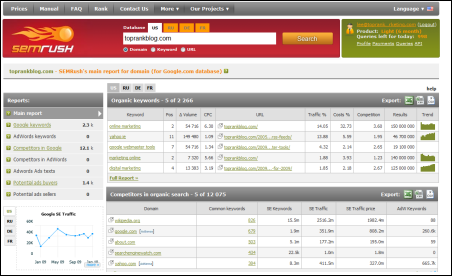
SEMRush is an interesting tool for identifying the keyword visibility, both organic and PPC, on Google for pretty much any domain name you might be curious about. Your own or competitors for example. A common question for marketers is, “What are my competitors optimizing for?”. This tool helps uncover that insight and in combination with other standard and social keyword research, can be very helpful insight in a social media optimization program.
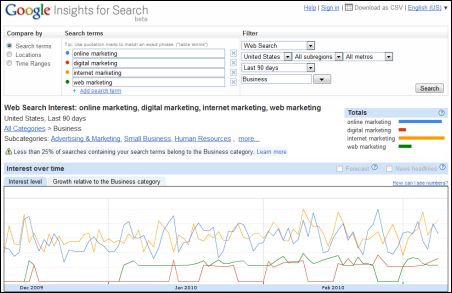
Google Insights for Search is a handy tool to research trends in popularity of various keywords on their own or in combination.  Filters for search type, geographic location, industry or topical category and timeframe allow you to refine some pretty useful information about what’s in demand.
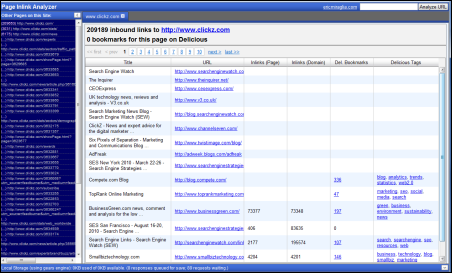
Eric Miraglia ‘s Inlink Analyzer is a back link analysis tool based on Yahoo’s Site Explorer that not only counts and displays source links to a particular URL, but it also shows if the source links were bookmarked on Delicious and what keyword tags were used. This kind of insight can be quite useful for understanding the relationship between social keywords and link popularity. It would be nice if there was a CSV export option.
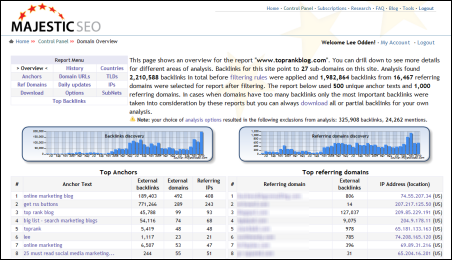
Majestic SEO is easily one of the most powerful and useful link analysis tools available. There is a free version that gives you link acquisition counts over time and if you are a site owner, you can get full reporting for your site once you validate it.  If you use the paid service, you can get the juicy link details on your competition.  This tools is useful for finding high impact links for standard SEO but it’s also useful for finding out which social media sites your site or competitors’ site are getting  the most links from.  Also, which of your own social destinations (blog, Facebook, Twitter, etc) are getting inbound links and from where.
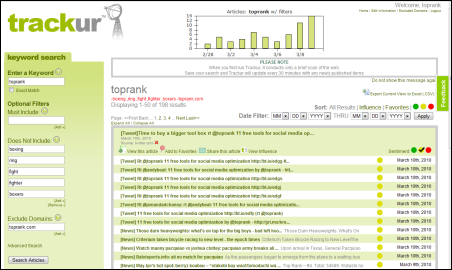
Andy Beal’s Trackur service is a very easy to use social media monitoring tool that offers a free version that will satisfy many beginners in the social media optimization space.  Social media monitoring services are keyword based, (queries and negative or exclusionary) and that means some very useful information about how popular certain keyword concepts are on the social web. Of course you can use it to monitor what people are saying about your brand, identify a certain measure of influence and where they’re saying it. But seeing social keyword popularity trends can be quite useful for taking advantage of real-time marketing opportunities.
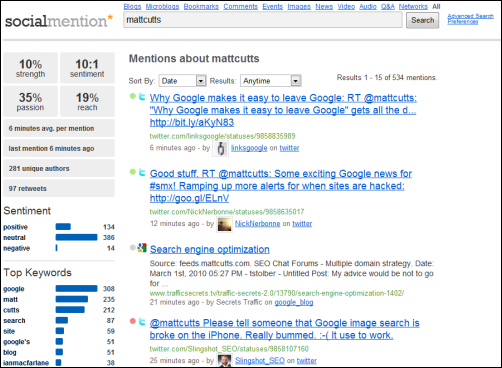
SocialMention is a free real time and social search tool that offers an array of search options (just blogs, just forums, just bookmarks or all) and output in the search results. You can get an indication of basic sentiment and the top social keywords associated with your query. As a free service, you don’t setup an account and save your search results, but you can easily download them into a spreadsheet. This is probably one of the most useful, free social search tools online.
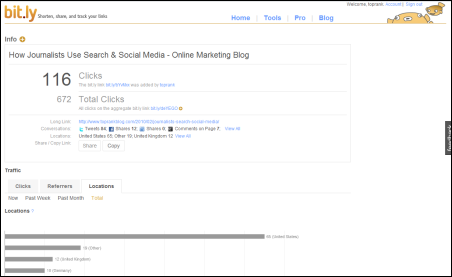
Bit.ly URL shortening is very handy since they’re included as a default service on Twitter and many other Twitter applications. Bit.ly is rock solid reliable with uptime, which is pretty critical when you’re relying on their URL redirect to send traffic to whatever it is you’re promoting. You can also get basic statistics for each URL that your shorten to show how productive the site is where it was shared.  In today’s succinct social web with Twitter, status updates and micro-content, being able to conserve space with a reliable URL shortener is very helpful. Stats on top of that make this a “go to” URL shortening service.
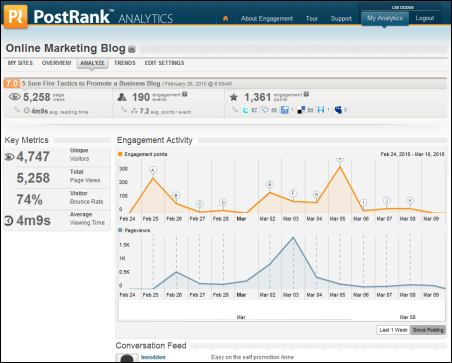
PostRank offers a nice measure of engagement at the individual document level and if you pay attention, you can get that data on any web site in their database, not just your own. You can easily see what content on your competitors blogs are getting popular and where.  If you sign up for the PostRank Analytics service, you can incorporate Google Analytics data with social engagement metrics. These are essential comparisons in a social media optimization program and can help you understand where to plan your time on the social web.
This is really just the tip of the iceberg when it comes to SEO and Social Media Marketing tools. What low cost or free tools have you found to be effective for social media optimization tasks?

Social Networking and Blog Sites More Popular – 75% of online users

Social Networking and Blog Sites getting even more poular, social
Social Networking
network or blog sites are visited by 75% of online users, reports Nielson.
Despite a fast-growing net population, India due to its present
low numbers, fails to appear in the list of top 10 socially networked countries.
A comparable developing country Brazil has highest percentage (86%) of Internet consumers visiting a social network. The popularity of social networking in Brazil is due to the Orkut phenomenon, which continues to be strong there. In India, Orkut is steadily losing ground to Facebook.
Social networking usage by country
Country
% Reach of Active Users
  • Brazil - 86%
  • Italy – 78%
  • Spain - 77%
  • Japan – 75%
  • United States – 74%
  • United Kingdom – 74%
  • France – 73%
  • Australia – 72%
  • Germany – 63%
  • Switzerland – 59%
Facebook has captured two-thirds of the active unique audience in Italy, making the site relatively more popular in Italy than in the three major English-speaking markets, Australia, the U.S. and the UK.
In contrast, Japanese people have the least appetite for Facebook, with reach and time spent markedly lower than in any of the other countries measured.
Facebook reach and usage by country
Country
% Reach of Active Users
  • Italy - 66%
  • Australia - 63%
  • United States - 62%
  • United Kingdom - 62%
  • Spain - 57%
  • France - 57%
  • Switzerland - 45%
  • Germany - 27%
  • Brazil - 26%
  • Japan - 3%
Thanks to Business Technology.in for this Information

Sunday, August 29, 2010

Twitter Campaign Learning’s

We have been running a campaign on Twitter for the last couple of months for a client of ours. While I cannot go into specifics about the campaign, I can share some of our learning’s:

Build Credibility
There is nothing worse than a Twitter account that only tweets sales offers. Unless your name is Dell you cannot build a following that way.
What we have found is that the Twitter account has to tweet useful information. To do this we set up accounts on a program called EasyTweets. EasyTweets allows us to add some RSS feeds to our Twitter account. These RSS feeds pull in news from the niches that we are targeting. So anyone who follows our account, will get news that they are interested in.

What does that look like?
Well if I was a restaurant in Nashua NH, I would add RSS feeds of Nashua news to my feed as may target audience is people who live in, and around, Nashua.
What we found was that if we added local and industry news to our Twitter feeds, we were able to increase the number of followers that we had. And since the feeds we added were of interest to our target audience, we were able to add followers who were interested in what we were selling.

Don’t Oversell
We have found that if for our client that the optimal number of “sales tweets” was one to two a day. And since the Twitter accounts were sending out 10-15 tweets a day from the RSS feeds, our “sales tweets” blended into the overall stream and did not look like all we were doing is selling on Twitter.

Test Content
Just like testing Ad copy for PPC, test and retest your sales tweet content. It is amazing what a difference changing one word can do for your CTR. Also, test the time of day of your offers. Do they convert better in the morning or afternoon?

Use Hashtags
Hashtags (#mets for example) is an massively underused Twitter feature. There are a lot of portal type web sites now that run continuous twitter steams. For example Metsblog.com is aimed at New York Mets fans and averages 2.5 million page views every month in traffic, and is read by roughly 35,000 unique people every day. Metsblog.com has a twitter feed page on its site that pulls in Tweets that use the tag #mets.
So if your target audience is Mets fans, and you use the #mets tag in your tweets, then suddenly your tweet is getting exposed to 35,000 mets fans. Multiple that by the hundreds of Mets web sites that are online and suddenly your reach is much greater than the 1,000 followers that you have. Your tweets are now being seen and read by tens of thousands of people.

source: http://social-media-optimization.com/2010/07/twitter-campaign-learning%E2%80%99s/

Social Networks and Recruiting

According to a survey by recruiting platform Jobvite nearly three-quarters of companies surveyed are using social networks for recruiting, and 58.1% said they had successfully hired a candidate found through a social network.

LinkedIn was the top social network looked to for hiring, used by nearly 80% of companies recruiting through social media. It also provided the most success, with about 90% of companies who had hired through a social network reporting they found the candidate on LinkedIn. While Facebook and Twitter were used for recruiting by about 55% and 45% of companies, respectively, they led to far fewer hires: 27.5% for Facebook and 14.2% for Twitter.
Success in this area is leading almost half of employers to increase recruiting program spending on social media. At the same time, more than a third of companies were lowering spending on job boards and search firms.

“While the economy begins to recover, companies looking to make new hires are seeking the most cost-effective, efficient ways to find new talent. As our third annual survey shows, social network recruiting has become a mainstream channel for employers who need access to talent,“ said Dan Finnigan, President and Chief Executive Officer of Jobvite. “Job boards launched a revolution in recruiting more than 15 years ago. And now, social networks are doing the same – but in a targeted way. Through social recruiting, companies are learning they can find the best talent efficiently, without making a major investment.“

source:http://social-media-optimization.com/2010/08/social-networks-and-recruiting/

Top Methods to Improve Your Blog Rank

Improve blog ranking and marketing is no longer kids stuff. It’s beyond the sappy diary entries and torment fueled rants. Its serious business, especially if your goal is to make money blogging for your business. Blog marketing is more dominant than static site marketing mainly because of all the options Web 2.0 offers. Below are some things you can do to take advantage of what web 2.0 has to offer to boost blog traffic, links and engine ranking.

1. Get exposed

Do you wonder how some large news and content sites deliver their headlines. Syndicate with RSS. While using the feed that comes with your blog may seem like an ok option, using a custom feed, that particularly separates keyword groups for content you develop often, is a far better option. Syndicating with RSS increases your exposure. Pheedpress, accessible from Content Desk is a great tool for this.

2. Tag you’re it!

Tags make it easier for people to find your blog post, and video and photos that are related. You can write the most informative blog in your niche but if it can not be found it can not get read. Tag your posts.

3. Social Bookmarking

Social Bookmarking allows users to save and categorize a personal collection of bookmarks and share them with others. Users may also take bookmarks saved by others and add them to their own collection, as well as to subscribe to the lists of others.

Bookmarking is an easy way to improve blog ranking and get traffic; the more you do it the more youll be noticed. Ideally, your site should be bookmarked somewhere in all the major bookmarking engines. For more details you can visit us at www.profit-pulling-tollbars.com. But having your entire site booked in just a few can greatly increase blog traffic.

4. Get involved

much like the tip above, adding comments is a great way to sprinkle your links around. Note however, your comment must be informative and relate to the original post. Bloggers will grant your trackbacks when your comments are on topic and useful.

5. Get connected

Social networks like Myspace can be found in nearly everywhere corner of the web. They are great places to meet like minded people and above all receive important links from.

Article syndication is still one of the most popular ways to get links. Well-written content that serves the reader first then your business will receive rewards. This is the type of content that is read, passed on, and linked to. Writing content gives you links as well as branding you as an authority figure in your niche.

6. Digging for treasure

some sites take stories from users and post them on the site. Users then vote on them and decide which get dugg and which are buried. If you are dugg it can result in a flood of traffic.

Use the above tips to take full advantage of all the rewards blogging can have on your business and to be able to make money blogging.
Publishing on a blog platform gives you the chance to reach a greater quantity of people faster than a static site.


source: http://www.seoseonews.com

Meta Title Tags are Gold

How to Write Compelling Page Titles

From an SEO perspective, the title of the webpage is very important. These are the words that describe what your page is about and are the first words that a search engine sees when it crawls your webpage looking for content to add to its index.

The page title is also what the searcher sees in a search result - so the page title is very important in describing what the page is about and if the title meets the searcher's criteria, then it is more likely to be clicked on and your page opened.

It is safe to assume that the majority of searchers these days will be tempted to either click or ignore based on the content of the title. This is like your ad in the natural search section of the search engine results page.

Now that the impact of the title of the webpage is obvious, let me explain how to write an effective and powerful title.

First the basics! The webpage title aka the title tag is the synopsis of the content of the web page. So, as no two pages on your website are the same, hence why should their title tags be? Therefore, as a general rule, title tags for each page on your website should be unique. This is an added bonus from an SEO perspective, because now you can target many more keywords and spread your reach across search engine indexes.

The second thing to consider is whether you want to add your company name in the title tag? The answer is that it depends on your branding strategy. If your company name is a known brand, or if you want to promote your firm name as a brand or if your company name consists of keyword(s) that you want to target such as ABC Family Solicitors targeting the keyword "Family Solicitors", then by all means add your company name in the title tag. If not, then use the limited but valuable space to add your targeted keywords. If you do decide to add your company name, make sure that it is at the end of the title. This is because you want search engines and your visitors to first read the targeted keyword(s) for that page and then the company name.

It is important to remember that since the title tag is the synopsis of the content of the web page, you need to make sure that the title tag is relevant. For example, the title tag for an about us page is "About Website Design Company - ECommerce Partners". Hence, the title tag does its job of informing what the page is about. Now, you might have noticed that instead of "About Us - ECommerce Partners", we added "About Website Design Company - ECommerce Partners".

The reason is because "Website Design Company" is one of the key phrases we want to target and so, we replaced "About Us" with "About Website Design Company". This brings out an important point. We need to do a keyword analysis before we write an effective and powerful title tag. 

The next step after keyword analysis will be to write down title tags for each and every web page on your website.

Please be careful when writing title tags and never, never over stuff keywords in the title. Doing so will undermine the power of the title tag and defeat the purpose of better ranking in the search engines. The title tag is the title of your web page and so it must be relevant and meaningful. Remember, this is the title in your AD in the natural search listings of the search engine.

General Suggestion: You cannot promote all of your keywords in one page. Normally, you should promote 3 to 5 keyword phrases per page. The 'Title tag' should contain up to 3 important keywords that match to the body of the page content. If the keyword you are trying to promote is highly competitive, you can consider repeating the important keyword twice in the first 100 words of the page content.

Limit the length of the title keywords to 65 characters or less, including spaces. There's no reason to have the engines cut off the last word and have it replaced with a "..." Note that some search engines are now accepting longer titles and Google, in particular, is now supporting up to 70 characters.

Use a divider when splitting up the keywords. We generally recommend the use of the "|" symbol aka the pipe bar. Others choose the arrow ">" or hyphen "-" and both work well.

Re-using the title tag of each page as the H1 heading tag can be valuable from both a SEO keyword targeting standpoint and a user experience improvement. Users who go to the page from the search result listing will have the expectation of finding the title they clicked on. Users will be more likely to stay on a page they're reasonably certain fits their intended search query.


source: http://www.seo-news.com/

Friday, August 13, 2010

Facebook Ads versus Google Adwords

Google Adwords has dominated the online advertising space for the last three or four years but Facebook I believe is positioned to really challenge Google for some of those advertising dollars.
We recently ran a series of campaigns for local events on Facebook and I was really impressed with the ROI that we got. It was much higher than anything that we have gotten using Adwords. So how did we do it?

Demographic Targeting

Unlike Adwords, Facebook users are not actively searching for your product or service. But by using Facebook’s demographics and location data we were able to really focus on our target audience.
Since our campaign was specific to a location we were able to target just the people who liked the brand we were promoting and who lived within 50 miles of the event.

This ended up being a really small group, but that was ok because the conversion event and CPC was really good.

Use Pictures

We tested ads with pictures and ads without. The ads with pictures all performed substantially better than those without.

Test Multiple Ads

When we run a paid campaign we always use multiple ad text, but it really is useful on Facebook. We tested new ad content every day until we were sure we had the most optimized copy. Then we let that as run until the end of the campaign.

source: http://social-media-optimization.com

Online Surveys & Social Media

One of the many ways companies have engaged their customers, gained insight into a marketplace and conducted research for a variety of purposes has been through surveys.  If you think that list of activities almost sounds like the reasons many companies engage in social media monitoring, you’d be right.
About 2 weeks ago I did a webinar with our client, Zoomerang, purveyor of online survey software on the intersection of surveys and social media. In that presentation I focused on why social media can play an important part of an online marketing strategy.
Companies incorporate social media into their marketing mix for a variety of reasons:
  • Website Traffic
  • Brand Awareness
  • Engagement with Prospects
  • Engagement with Customers
  • Brand Reputation
  • Prospect Lead Quality
  • Revenue
  • Prospect Lead Volume
  • Useful Product Feedback
Social media communities like Twitter with over 100 million accounts and Facebook with over 500 million present an attractive opportunity for research, engagement and marketing.   When incorporating surveys into a social media marketing mix, there’s an opportunity to make that intersection a part of your social cycle of interaction as pictured above.
For example here is how a company leveraging a survey for marketing purposes might incorporate their social networks with online surveys:
Put a listening program in place using social media monitoring software to get a handle on topics of interest to your community.  There could be a variety of reasons to use a survey, from product research to identifying trends or for profiling customers.
Grow your network, grow your survey panel. In the context of online surveys, growing a strong social network across different channels is a bit like developing your own survey panel.  As you grow your networks through participation and interaction, trust is earned.
Crowdsource ideas like survey questions.  Ping your network with different topics of questions to see what people respond to. Leverage that feedback to construct the flow of your online survey and even some of the questions.
Ask for help. Those same, topically relevant communities can be tapped to help promote the survey at large, in situations where respondents don’t need to be a specifically defined list.
Social Media Online SurveysRecognize those in your network that helped come up with question ideas as well as those that help promote taking the survey. That public recognition is priceless, especially when it’s a genuine reflection of their contribution to a successful survey.
Promote. Being invested through participation and recognition, there’s a great chance many of those same network connections will help promote the survey results. Offer a first look at the survey report, an incentive for promotion and communicate the outcome of everyone’s efforts. Give feedback on what’s working and if you can, offer tools to make it easier to promote.
You can listen to the entire recorded webinar here along with links to other articles and howtos for incorporating social media into your surveys and surveys into your social media.
Have you successfully incorporated social media into some aspect of your online surveys? Did you find some uses more effective than others?

source: toprankblog

Wednesday, July 14, 2010

B2B SEO is a Different Animal

When you start to perform search engine marketing and optimization for your own business website you really have to figure out whether you are attempting to market a business to a B2B or B2C audience. A consumer audience could very well read their email at midnight and purchase something but not a business audience. Your SEO efforts are going to be quite different depending on which type of person you are trying to attract.

Here are some key elements to look out for B2B SEO:
SEO Demand Generation: For companies that are targeting other businesses in a niche industry, often times they need to target keywords naturally within their content and the rest of the on site optimziation for keywords that have little search volume. This is when there are industry specific terminology that may not have a high search volume yet. But sometimes it makes sense to target a mix of both keywords that people are searching for and keywords that are industry specific that will grow over time. And even sometimes a b2b focused campaign can leverage (and should) other sources of online and offline marketing to help build new keyword search volume (and build a demand) within a specific target marketplace.
Online PR Timing: Whether you are distributing some PR or attacking the social media front your timing is going to be critical. You can’t expect to target a B2B audience creating efforts at 10 o’clock at night can you? You know your audience best so try to anticipate when the best time for something to land in front of them is. You don’t want to be wasting your efforts if nobody is going to see what you are doing. Timing things wrong could lead to absolutely nothing occurring on your website. Remember to keep testing different approaches.
Content Verbiage: It is safe to say that different keywords are going to attract different people. The word “cheap” is going to pull in a different audience than “inexpensive” so it is up to you to figure this out before you begin optimizing your website or putting together an internet marketing campaign. Put a large emphasis on the types of keywords you want to incorporate into your site and your plan. The wrong keywords could pull in the wrong audience which could be disastrous.
Your B2B audience will appreciate a methodical approach to your search engine optimization. Remember that it is an audience that just wants to get the business part done. Many of the decision makers are going to be managers, department directors and some business owners so they just want to see the information, how you are going to solve the problem at hand and what the cost will be to do it. It is a different type of mind set than reaching out to a consumer based audience which is usually driven on emotion and branding to purchase what they want.

Build Links Through Social Media


For the first years when social media made it onto the playing field of marketing companies where not sure what to do with it, now if you avoid it you could face a serious downfall with your business. SEO and social media go hand-in-hand and has become a crucial ingredient to marketing any business. There are however distinct methods to the madness that can help your websites SEO over time.


Contests: One of the goals of social media will be to have your audience push your message out through their channels by the form of retweets, Facebook like buttons and blog posts. That is when your efforts will really start to pay off how they should. When you can get an audience member writing a blog post on your promotion those natural links are going to lead to great SEO.


Viral: A viral marketing campaign pushed through the social channels can lead to an amazing amount of links pointing to your website. A great example of viral marketing is the Blendtec iPhone video that has reached an astonishing 8.5 million views on YouTube and generated something in the ball park of 6-7 thousands one way links. This is an example of social media creating a fierce amount of publicity and links.


Kicking and Screaming: Are you upset about something in your industry? Let the world know because it might just create some really nice one way links pointing your blog or website. People like it when others are mad about something, as strange as that sounds they might just jump into the conversation and help out spreading your message. This could also lead to some really great one way links pointing to your website over time.


All it really takes is some creative outside the box thinking. If you have a team of employees don’t be scared to get everyone’s input. Have a brainstorming session and get everyone’s say about how to really kick things up on the social front to generate some nice one way links pointing to your website. Social media is not just about letting people know you just made your coffee too hot it is also about leveraging your voice and your message.


source: searchengineoptimizationjournal


How to Create Content Specifically For Your Affiliate Product


The Internet is sometimes called one big advertisement. It is true that, since the first web sites began to appear, web designers have realized the potential of web driven product sales. It may seem like an impossible task to join the fight to make online sales today. However, the door is still wide open for you if you can learn how to create content that is valuable to readers and how to create content specifically for your affiliate product. There are a few considerations that you must keep in mind.
Striking a Healthy Balance Between Promotion and Value
One of the worst things that you can do when creating content specifically for an affiliate product is to make the content one big sales pitch. Anyone that has spent even a little time hunting for products on the Internet knows exactly what such content looks like. It provides little information that is not opinionated and gives no real information. In fact, all it does is prop up a product or service as the best without giving a reason why.
Instead, use a writing technique called selective informational reviewing. This is the same technique that many documentary film makers and some news channels use to spin information. All that you need to do is write a review that gives solid information about the product without including a single opinionated statement. For example, compare the following statements. Both are intended to sell the product but only one is valuable:
Company Inc. is the best company out there for white bread.
Company Inc. bakes their white bread with all natural ingredients and old fashioned clay ovens.
Don’t Just Review – Reveal
One of the worst things that you can do on your web site is to just build an enormous review center. Generate content that not only promotes an affiliate product, but informs your readers about the product itself. For example, a reader might not know the benefit of choosing white bread made from all natural ingredients if they do not know the health benefits of doing so, the methods used to create such bread, the source of the ingredients, etc.
You might also consider creating some content about the history of bread baking to rank for the keyword bread (a challenge, yes) or inform your readers how much fresh bread can be when made like it was in the past. Pretend like your readers have no clue what your affiliate product is. The more information that you can include to increase the strength of your claims, the better.
If you are paying content writers to write your content for you, make sure that you are giving them the proper guidelines. If you expect a writer to just automatically know what to do then you are going to have a lot of issues with the content. If you want your content to be generated specifically for your affiliate product, then you need to let your writers know about that. Give them the details and goals that you have in mind.
source: niceblogger